Showing posts with label ´1972. Show all posts

The Moody Blues - Seventh Sojourn (1972)

"Seventh Sojourn", released in 1972, is the seventh studio album by The Moody Blues in their "classic" lineup and their eighth album overall.
On this album, The Moody Blues used, besides the Mellotron, a similar keyboard called the Chamberlin; both were created by Harry Chamberlin. The newer device simulated orchestral sounds more realistically and easily than the Mellotron. Several songs contain overt political references. Mike Pinder's "Lost in a Lost World" laments the brutality of revolution ("Revolution never won / It's just another form of gun") and racial tension ("In their eyes it's nation against nation against nation / With racial pride"). "You and Me," like "Question" from two years earlier, alludes to ongoing wars and conflicts, including Vietnam ("There's a leafless tree in Asia"), Africa ("Under the sun there's a homeless man"), and the Arab-Israeli conflict ("There's a forest fire in the valley / Where the story all began"). "The Moody Blues: Legend of a Band," Bassist John Lodge described "I'm Just a Singer (In a Rock and Roll Band)" as a response to fans who mistakenly read guru-like wisdom into the Moodies' often philosophical lyrics. The song makes a clear statement that the band is just as worried by the crises of the modern world and has just as few answers as everyone else. In contrast, "The Land of Make-Believe" describes a utopian world where "heartaches can turn into joy." This highly melodic track employs a complex and counterpoint-filled accompaniment in which contrasting lines are introduced in succession: First by the acoustic guitar (played by Hayward), then bells (Edge), then bass (Lodge), flute (Thomas), and finally electric guitar (Hayward again). Each part is unique, but ultimately blends well with the others, in keeping with the theme of the song's lyrics ("Only love will see us through / You know what love can do to you").
Two hit singles came from this album: "Isn't Life Strange" and "I'm Just a Singer (In a Rock and Roll Band)".

Tracklist
01.  "Lost in a Lost World"  (Mike Pinder)  - 4:42
02.  "New Horizons"  (Justin Hayward)  - 5:11
03.  "For My Lady"  (Ray Thomas)  - 3:58
04.  "Isn't Life Strange"  (John Lodge)  - 6:09
05.  "You and Me"  (Hayward, Graeme Edge)   - 4:21
06.  "The Land of Make-Believe"  (Hayward)  - 4:52
07.  "When You're a Free Man"  (Pinder)  - 6:06
08.  "I'm Just a Singer (In a Rock and Roll Band)"  (Lodge)  - 4:18

Personnel
Justin Hayward - vocals, guitar
John Lodge - vocals, bass
Ray Thomas - vocals, flute, tambourine
Graeme Edge - drums, percussion, vocals
Mike Pinder - vocals, chamberlin, mellotron

Notes
Released:  17 October 1972
Recorded at:  Decca Tollington Park Studios, London
Genre:  Progressive Rock, Psychedelic Rock
Length:  39:29
Label:  Threshold Records
Producer:  Tony Clarke

Johnny Cash - A Thing Called Love (1972)

"A Thing Called Love" is the 38th overal album by country singer Johnny Cash, released on Columbia Records in 1972.
Having released two incredible live albums from prisons in the late 60s, hosted his own network tv show for three seasons, won every award known to mankind up to that point, Cash was still touring and making great records. "A Thing Called Love," was released during this time. Nearly every song is a stand out in its' own way. Three singles were pulled from it. "Kate" and the title cut both going top three, and "Papa was a Good Man" finishing in the teens. Other great songs include Cash's wedding present to June Carter, "I Promise You," and the eerie sounding great song "Melva's Wine." Larry Butler produced this album, and occasionally will over do the bass, such is the case on Melva's Wine but overall this is a fine example of Johnny Cash seventies music.
The album also never seems to come together.  The approach to many of the songs is disjointed, with guitar parts draped with vocal choruses and strings that just don't quite fit.  Cash also struggles to find a good vocal cadence for many of the songs.  Cash himself has claimed some of this work around this time was marginal because his focus was instead on his movie and album project The Gospel Road.  In the end this one is not bad, and marginally more interesting than Any Old Wind That Blows, but otherwise it is one of Cash's lesser albums of the early 1970s.

Tracklist

01.  "Kate"  (Marty Robbins)  - 2:22
02.  "Melva's Wine"  (Vincent Matthews)  - 2:55
03.  "A Thing Called Love"  (Jerry Reed Hubbard)  - 2:36
04.  "I Promise You"  (Cash)  - 2:58
05.  "Papa Was a Good Man"  (Hal Bynum) - 2:38
06.  "Tear Stained Letter"  (Cash)  - 2:45
07.  "Mississippi Sand"  (June Carter Cash)  - 3:08
08.  "Daddy"  (Don Reid, Harold Reid)  - 2:54
09.  "Arkansas Lovin' Man"  (Red Lane)  - 2:51
10.  "The Miracle Man"  (Cash, Larry Lee)  - 3:30

Personnel
Johnny Cash – Vocals, Guitar
The Evangel Temple Choir – Background Vocals
The Carter Family – Background vocals
Marshall Grant – bass
W.S. Holland- drums
Bob Wootton - guitar
Carl Perkins - guitar
Ray Edenton - guitar
Jerry Reed – guitar
Tommy Allsup – acoustic guitar
Charlie McCoy – harmonica
Bill Pursell – piano
Larry Butler – piano

Notes
Released:  April 1972
Genre:  Country
Length:  28:37
Label:  Columbia
Producer:  Larry Butler

(42) Deep Purple - Machine Head (1972)


"Machine Head" is the sixth studio album released by the English rock band Deep Purple. It was recorded through December 1971 in Montreux, Switzerland, and released in March 1972.
"Machine Head" is often cited as influential in the development of the heavy metal music genre. It is Deep Purple's most successful recording,
Led Zeppelin's fourth album, Black Sabbath's Paranoid, and Deep Purple's Machine Head have stood the test of time as the Holy Trinity of English hard rock and heavy metal, serving as the fundamental blueprints followed by virtually every heavy rock & roll band since the early '70s. And, though it is probably the least celebrated of the three, "Machine Head" contains the "mother of all guitar riffs" and one of the first learned by every beginning guitarist in "Smoke on the Water." Inspired by real-life events in Montreux, Switzerland, where Deep Purple were recording the album when the Montreux Casino was burned to the ground during a Frank Zappa concert, neither the song, nor its timeless riff, should need any further description. However, "Machine Head" was anything but a one-trick pony, introducing the bona fide classic opener "Highway Star," which epitomized all of Deep Purple's intensity and versatility while featuring perhaps the greatest soloing duel ever between guitarist Ritchie Blackmore and organist Jon Lord. Also in top form was singer Ian Gillan, who crooned and exploded with amazing power and range throughout to establish himself once and for all as one of the finest voices of his generation, bar none. Yes, the plodding shuffle of "Maybe I'm a Leo" shows some signs of age, but punchy singles "Pictures of Home" and "Never Before" remain as vital as ever, displaying Purple at their melodic best. And finally, the spectacular "Space Truckin'" drove Machine Head home with yet another tremendous Blackmore riff, providing a fitting conclusion to one of the essential hard rock albums of all time.

Track listing

1.  Highway Star  (Blackmore, Gillan, Glover, Lord)  - 6:05
2.  Maybe I'm a Leo  (Blackmore, Gillan, Glover, Lord)  -  4:51
3.  Pictures of Home  (Blackmore, Gillan, Glover, Lord)  - 5:03
4.  Never Before  (Blackmore, Gillan, Glover, Lord)  - 3:56
5.  Smoke on the Water  (Blackmore, Gillan, Glover, Lord)  - 5:40
6.  Lazy  (Blackmore, Gillan, Glover, Lord)  - 7:19
7.  Space Truckin'  (Blackmore, Gillan, Glover, Lord)  - 4:31

Released:  March 1972
Recorded:  Montreux, Switzerland
Genre:  Hard Rock, Heavy Metal
Length:  37:25
Label:  Purple Records/EMI
Producer:  Deep Purple

Personnel
Ritchie Blackmore – guitar
Ian Gillan – vocals, harmonica
Roger Glover – bass
Ian Paice – drums, percussion
Jon Lord – keyboards

(41) David Crosby & Graham Nash - Graham Nash/David Crosby (1972)


"Graham Nash/David Crosby" is the first album by the partnership of David Crosby and Graham Nash, released on Atlantic Records in 1972.
After the split of Crosby, Stills, Nash & Young in the summer of 1970, all four members would release solo albums over the course of the ensuing twelve months.
This self-titled release is one of if the most impressive side project to arise from CSN. Taken beyond face value, Graham Nash/David Crosby is a direct reflection, if not an extension, of the musical and personal relationship between its co-creators. Likewise, the results remain true, enhancing rather than detracting from the very individualistic styles of Crosby and Nash. The best elements of each are readily available here, punctuated at every turn by their complicated vocal arrangements and air-lock harmonies. In the wake of the enormous successes garnered by the albums "Crosby Stills & Nash", "Déjà Vu", and "Four Way Street", the principal members were essentially given carte blanche studio access to pursue solo projects as well. This release is the first in what would turn out to be a series of collaborative efforts between Crosby and Nash. Musically it continues in much the same vein as their respective debut solo releases, "If I Could Only Remember My Name" and "Songs for Beginners". Nash's contributions include "Girl to Be on My Mind," "Stranger's Room," and "Southbound Train" a twangy piece of Americana featuring a high and lonesome steel guitar solo from Jerry Garcia that likewise hearkens to the Grateful Dead's American Beauty, Elton John's "Tumbleweed Connection", or the Band's "Music From Big Pink". These tracks co-exist in stark contrast to Crosby's more cerebral and incisive contributions, such as "Whole Cloth," "Games," and "The Wall Song." The latter features some outstanding instrumental support from the Grateful Dead's Jerry Garcia (guitar), Phil Lesh (bass), and Billy Kreutzman (drums). The core band revolves around another set of all-stars: Russell Kunkel (drums), Leland Skylar (bass), Craig Doerge (keyboards), and Danny "Kootch" Kortchmar (guitar). This same band would more or less continue to back up Crosby and Nash's duo efforts throughout the remainder of the '70s. "Graham Nash/David Crosby" offers much of the same unique songwriting and personal style which informed their better contributions not only to the CSN-related efforts, but as far back as their offerings with the Hollies and the Byrds.

Track listing

01.  Southbound Train  (Nash)  - 3:54
02.  Whole Cloth  (Crosby)  - 4:35
03.  Blacknotes  (Nash)  - 0:58
04.  Stranger's Room  (Nash)  - 2:28
05.  Where Will I Be?  (Crosby)  - 3:23
06.  Page 43  (Crosby)  - 2:56
07.  Frozen Smiles  (Nash)  - 2:17
08.  Games  (Crosby)  - 2:59
09.  Girl to Be on My Mind  (Nash)  - 3:27
10.  The Wall Song  (Crosby)  - 4:37
11.  Immigration Man  (Nash)  - 3:02

Released:  April 5, 1972
Recorded at:  Wally Heider Studio III, Los Angeles, CA
Genre:  Soft Rock
Length:  35:26
Label:  Atlantic
Producer:  David Crosby, Graham Nash, Bill Halverson

Personnel
Graham Nash - guitar, harmonica, vocals
David Crosby - guitar, vocals
Jerry Garcia - pedal steel guitar
Chris Ethridge - bass
Johnny Barbata - drums
Danny Kortchmar - electric guitar
Craig Doerge - electric piano
Leland Sklar - bass
Russ Kunkel - drums
Dana Africa - flute
Phil Lesh - bass
Bill Kreutzmann - drums
Dave Mason - electric guitar
Greg Reeves - bass;
David Duke - french horns
Arthur Maebe - french horns
George Price - french horns

(40) Greenfield & Cook - Greenfield & Cook (1972)


Greenfield & Cook bestond uit Rink Groeneveld en Peter Kok uit Den Haag, beiden ex-Hurricanes en sinds 1967 als duo onder de naam Popshop. In 1969, gingen ze verder onder de naam Greenfield & Cook. In 1970 scoren zij met The End hun eerste tipparade-notering. Het komt van hun debuut album "Greenfield & Cook". De plaat wordt geproduceerd door Jaap Eggermont. De anderen singels van dit album zijn: ´Only Lies´ en ´Don´t Turn Me Loose´. Na in totaal zeven Top-40 noteringen gaan Greenfield & Cook in 1974 uit elkaar. Daarna beginnen beiden een solocarrière die nauwelijks succesvol te noemen is. Rink Groeneveld brengt in 1975 de single "He Loved You" uit. Verder produceert hij de single "Magic Mary" van de groep Holland.
Peter Kok wordt manager van Euson en verruilt in 1977 Apeldoorn voor Amerika. Als succes uitblijft vertrekt hij een jaar later naar Chili om eigenaar van een Chileense platenmaatschappij te worden.

Track listing

01.  Don't Turn Me Loose  - 2:12
02.  To Rob (What I Supposed to Do)  - 3:13
03.  Where - 3:37
04.  Darling, Darling  - 2:19
05.  Going Home  - 3:16
06.  Baby Don't Cry  - 2:42
07.  Only Lies  - 3:27
08.  All over the World  - 2:15
09.  It's Up to You (part One)  - 1:16
10.  It's Up to You (Part Two)  - 3:04
11.  Gone  - 2:25
12.  The End  - 3:45

Released:  1972
Label:  Polydor
Genre:  Pop
Lengte:  33:31
Producer:  Jaap Eggermont

Personnel
Rick Greenfield - Vocals, Guitar [Acoustic]
Peter Cook - Vocals, Guitar [Acoustic]
Piet Zonneveld - Accordion
Piet Hein Veening - Bass
Louis Debij - Drums
Guitar – Hans Hollestelle - Guitar
John Lagrand - Harmonica [Mouth Organ]
Frans Mijts - Horn [Flugel]
Freek Berrier - Piano
Frans Doolaard - Steel Guitar [Pedal]
Cees Schrama - Synthesizer

(39) The New Seekers - We'd Like To Teach The World To Sing (1972)


The New Seekers are a British-based pop group, formed in 1969 by Keith Potger after the break-up of his group, The New Seekers featuring Laurie Heath, Chris Barrington, Marty Kristian, Eve Graham and Sally Graham. Potger himself also performed and recorded with the group. After one single release, the line-up was reworked in 1970 to Eve Graham, Lyn Paul, Marty Kristian, Peter Doyle and Paul Layton
The idea was that The New Seekers would appeal to the same market as the original Seekers, but their music had rock as well as folk influences. They achieved worldwide success in the early 1970s. With a line-up of newly recorded tracks, the group released an album under the same name in the UK and Europe in March 1972. As well as featuring the single "I'd Like to Teach the World to Sing", which had reached #1 in the UK, it also featured their then current single, "Beg, Steal or Borrow". This latter single was their entry into the 1972 Eurovision Song Contest, where it gained second place as well as reaching #2 in the UK singles chart. As well as this, two other songs, which they had performed in the heats were included: "One by One" and "Songs of Praise".

Track listing

01.  Dance Dance Dance  (young)  - 2:04
02.  Georgie Girl/ Ticket to Ride  (Springfield, Dale, Lennon-McCartney)  - 2:58
03.  I'd Like to Teach the World to Sing  (Backer, Davis, Greenaway, Cook)  - 2:20
04.  Changes IV  (Stevens)  - 2:45
05.  One by One  (Leander, Sego)  - 3:06
06.  I Can Say You're Beautiful  (Doyle)  - 3:42
07.  Beg, Steal or Borrow  (Cole, Hall, Wolfe)  - 2:45
08.  The World I Wish for You  (Greenaway, Cook)  - 2:27
09.  Wanderer's Song  (Poulson)  - 2:42
10.  Just an Old Fashioned Love Song  (Williams)  - 2:41
11.  Songs of Praise  (Wood)  - 2:38
12.  Mystic Queen  (Kristian)  - 4:02

Released:  March 1972
Recorded at:  Morgan Studios & I.B.C. Studios, London
Genre:  Pop
Label:  Polydor
Length:  34:18
Producer:  David MacKay

Personnel
Lyn Paul - vocals
Peter Doyle - vocals
Paul Layton - vocals
Marty Kristian - vocals
Eve Graham - vocals

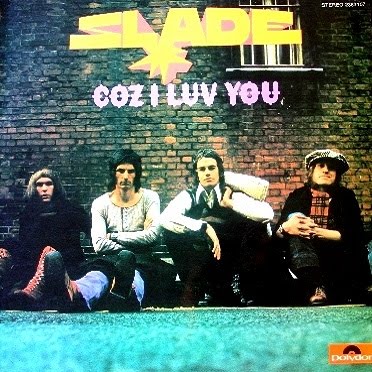
(38) Slade - Coz I Luv You (1972)


Slade are a rock band from Wolverhampton, who rose to prominence during the glam rock era of the early 1970s.
This album was a compilation of early Slade singles & album tracks released several times in Europe.
Slade may have never truly caught on with American audiences (often narrow-mindedly deemed "too British-sounding"), but the group became a sensation in their homeland with their anthemic brand of glam rock in the early '70s.
After several albums featuring few original compositions from the quartet came and went (1969's Beginnings, 1970's Play It Loud), the group began to write their own tunes, grew their hair long, and assumed the look of the then-burgeoning glam movement, joining the same cause championed by such fellow Brits as David Bowie and T. Rex. This new direction paid off in 1971 with the number 16 U.K. single "Get Down and Get With It," which soon touched off a string of classic singles and led to Slade becoming one of the most beloved party bands back home. Slade also utilized another gimmick, humorously misspelled song titles, as evidenced by such singles as "Coz I Luv You," "Look Wot You Dun," "Take Me Bak 'Ome," "Mama Weer All Crazee Now," "Gudbuy t'Jane," "Cum on Feel the Noize," "Skweeze Me, Pleeze Me," and "Merry Xmas Everybody".

Track listing

01.  Coz I Luv You  (Neville Holder & Jim Lea)  - 3:23
02.  Dapple Rose  (Jim Lea & Don Powell)  - 3:25
03.  My Life Is Natural  (Neville Holder)  - 3:12
04.  Angelina  (Innes)  - 2:45
05.  Candidate  (Jim Lea & Don Powell)  - 2:50
06.  Sweet Box  (Jim Lea & Don Powell)  - 3:20
07.  Look Wot You Dun  (Neville Holder, Jim Lea & Don Powell)  - 2:56
08.  Could I  (Griffin & Royer)  - 2:45
09.  Raven  (Neville Holder, Jim Lea & Don Powell)  - 2:30
10.  Gospel According To Rasputin  (Dave Hill & Neville Holder)  - 4:20
11.  The Shape Of Things To Come  (Mann & Weil)  - 2:15
12.  Get Down And Get With It  (Bobby Marchan)  - 3:45

Release:  1972
Label:  Polydor
Genre:  Hard Rock, Glam Rock
Length:  37:26
Producer:  Chas Chandler

Personnel
Noddy Holder - lead vocals, rhythm guitar
Dave Hill - lead guitar
Jim Lea - bass guitar, piano
Don Powell - drums

(37) Creedence Clearwater Revival - Mardi Gras (1972)


"Mardi Gras" is the seventh and final studio album by American band Creedence Clearwater Revival, released in 1972. The group broke up after this album was released.
Pared down to a trio, Creedence Clearwater Revival had to find a new way of doing business, since already their sound had changed, so they split creative duties evenly. It wasn't just that each member wrote songs they produced them, too. Doug Clifford and Stu Cook claim John Fogerty needed time to creatively recharge, while Fogerty says he simply bowed to the duo's relentless pressure for equal time. Both arguments make sense, but either way, the end result was the same: "Mardi Gras" was a mess. Not a disaster, which it was dismissed as upon its release, since there are a couple of bright moments. Typically, Fogerty is reliable, with the solid rocker "Sweet Hitch-Hiker," the country ramble "Lookin' for a Reason," a good cover of Ricky Nelson's "Hello Mary Lou," and the pretty good ballad "Someday Never Comes." These don't match the brilliance of previous CCR records, but they sparkle next to Clifford and Cook's efforts. That implies that their contributions are terrible, which they're usually not they're just pedestrian. Only "Sail Away" is difficult to listen to, due to Cook's flat, overemphasized vocals, but he makes up for it with the solid rocker "Door to Door" and the Fogerty soundalike "Take It Like a Friend." Clifford fares a little better since his voice is warmer and he wisely channels it into amiable country-rock, yet these are pretty average songs by two guys beginning to find their own songwriting voice. If Clifford and Cook had started their own band (which they did after this album) it would be easier to be charitable, but when held up against Creedence's other work, "Mardi Gras" withers. It's an unpretty end to a great band.

Track listing

01.  Lookin' for a Reason  (John Fogerty)  - 3:28
02.  Take It Like a Friend  (Stu Cook)  - 3:00
03.  Need Someone to Hold  (Cook, Doug Clifford)  - 3:00
04.  Tearin' Up the Country  (Clifford)  - 2:14
05.  Someday Never Comes  (Fogerty)  - 4:01
06.  What Are You Gonna Do?  (Clifford)  - 2:53
07.  Sail Away  (Cook)  - 2:29
08.  Hello Mary Lou  (Gene Pitney, Cayet Mangiaracina)  - 2:14
09.  Door to Door  (Cook)  - 2:09
10.  Sweet Hitch-Hiker  (Fogerty)  - 2:59

Released:  April 11, 1972
Genre:  Roots Rock, Country Rock, Swamp Rock, Southern Rock
Length:  28:04
Label:  Fantasy
Producer:  Doug Clifford, Stu Cook, John Fogerty

Personnel
Doug Clifford - drums, vocals
Stu Cook - bass, rhythm guitar, lead guitar, piano, vocals
John Fogerty - lead guitar, rhythm guitar, keyboards, vocals

(36) Manassas - Manassas (1972)


Manassas was an American rock band, formed by Stephen Stills in 1971.
"Manassas" is their 1972 debut double album.
Rock, folk, blues, country, Latin, and bluegrass have all been styles touched on in Stephen Stills' career, and the skilled, energetic musicians he had gathered in Manassas played them all on this album. What could have been a disorganized mess in other hands, though, here all gelled together and formed a cohesive musical statement. The songs are thematically grouped: part one (side one on the original vinyl release) is titled "The Raven," and is a composite of rock and Latin sounds that the group would often perform in full live. "The Wilderness" mainly centers on country and bluegrass (Chris Hillman's and Al Perkins' talents coming to the forefront), with the track "So Begins the Task" later covered by Stills' old flame Judy Collins. Part three, "Consider" is largely folk and folk-rock. "Johnny's Garden," reportedly for the caretaker at Stills' English manor house and not for John Lennon as is often thought, is a particular highlight. Two other notables from the "Consider" section are "It Doesn't Matter" (later redone with different lyrics by the song's uncredited co-writer Rick Roberts on the first Firefall album) and "Move Around," which features some of the first synthesizer used in a rock context. The closing section, titled "Rock & Roll Is Here to Stay," is a rock and blues set with one of the landmarks of Manassas' short life, the epic "The Treasure." A sort of Zen-like meditation on love and "oneness," enlivened by the band's most inspired recorded playing it evolves into a bluesy groove washed in Stills' fierce electric slide playing. The delineation lines of the four themed song groupings aren't cut in stone, though, and one of the strengths of the album is that there is a lot of overlap in styles throughout.

Track listing

The Raven
1.  Song of Love  (Stephen Stills)  - 3:28
2.  Medley  - 3:34
     (a) Rock & Roll Crazies  (Stephen Stills, Dallas Taylor)
     (b) Cuban Bluegrass  (Stephen Stills, Joe Lala)
3.  Jet Set (Sigh)  (Stephen Stills)  - 4:25
4.  Anyway  (Stephen Stills)  - 3:21
5.  Both of Us (Bound to Lose)  (Stephen Stills, Chris Hillman)  - 3:00

The Wilderness
1.  Fallen Eagle  (Stephen Stills)  - 2:03
2.  Jesus Gave Love Away for Free  (Stephen Stills)  - 2:59
3.  Colorado  (Stephen Stills)  - 2:50
4.  So Begins the Task  (Stephen Stills)  - 3:57
5.  Hide It So Deep  (Stephen Stills)  - 2:44
6.  Don't Look at My Shadow  (Stephen Stills)  - 2:30

Consider
1.  It Doesn't Matter  (Chris Hillman, Rick Roberts, Stephen Stills)  - 2:30
2.  Johnny's Garden  (Stephen Stills)  - 2:45
3.  Bound to Fall  (Mike Brewer, Tom Mastin)  - 1:53
4.  How Far  (Stephen Stills)  - 2:49
5.  Move Around  (Stephen Stills)  - 4:15
6.  The Love Gangster  (Stephen Stills, Bill Wyman)  - 2:51

Rock & Roll is Here to Stay
1.  What to Do  (Stephen Stills)  - 4:44
2.  Right Now  (Stephen Stills)  - 2:58
3.  The Treasure (Take One)  (Stephen Stills)  - 8:03
4.  Blues Man  (Stephen Stills) (In tribute: Jimi Hendrix, Al Wilson, Duane Allman)  - 4:04

Released:  April 12, 1972
Recorded:  Criteria Sound Studios, Miami, Florida
Genre:  Country Rock
Length:  70:07
Label:  Atlantic Records
Producer:  Stephen Stills, Chris Hillman, Dallas Taylor

Personnel
Stephen Stills - vocals, guitar, bottleneck guitar, piano, organ, electric piano, clavinette
Chris Hillman - vocals, guitar, mandolin
Al Perkins - pedal steel guitar, guitar, vocals
Calvin "Fuzzy" Samuel - bass
Paul Harris - organ, tack piano, piano, organ, electric piano, clavinette
Dallas Taylor - drums
Joe Lala - percussion, vocals
Sydney George - harmonica
Jerry Aiello - piano, organ, electric piano, clavinette
Bill Wyman - bass
Roger Bush - acoustic bass
Byron Berline - fiddle
Jerry Garcia - pedal steel guitar

(16) Jethro Tull - Thick As A Brick (1972)


"Thick As A Brick" is a concept album, and the fifth studio album, by the English progressive rock band Jethro Tull released in 1972. Its lyrics are based on a poem written by a fictitious boy, Gerald Bostock, said to have been adapted to music by Jethro Tull although the band's Ian Anderson in fact wrote the lyrics himself. The album features only one song, lasting nearly 44 minutes.
Mixing hard rock and English folk music with classical influences, set to stream-of-consciousness lyrics so dense with imagery that one might spend weeks pondering their meaning assuming one feels the need to do so the group created a dazzling tour de force, at once playful, profound, and challenging, without overwhelming the listener.
The music on here drowns in it's own sophistication, refinement and high-class; the musicianship and it's high-class is something that shouldn't be taken too lightly, and should be the envy of many a musician and a listener. It starts off with acoustic guitar, followed by the flute, then Ian's vocals. The piece takes off from there. From there you will find tremendous melody, some hard rock, folk, jazz, and classical influences combined with many different shifts in tempo and time, and the band pulls no punches, as musical ideas keep flowing and flowing into each other like one huge piece, until the climactic end. It's divided into two halves. To be quite honest, the whole thing sounds like one gigantic classical piece, only with rock added.

Tracklist

1.  Thick as a Brick, Part I  - 22:40
2.  Thick as a Brick, Part II  - 21:06

Released:  10 March 1972
Recorded at:  Morgan Studios, London
Genre:  Progressive Rock
Length:  43:46
Label:  Chrysalis
Producer:  Ian Anderson
Written by:  "Gerald Bostock" (Ian Anderson)

Personnel
Ian Anderson – lead vocals, acoustic guitar, flute, violin, trumpet, saxophone
Martin Barre – electric guitar, lute
John Evan – piano, organ, harpsichord
Jeffrey Hammond - Bass guitar, Vocals
Barriemore Barlow – drums, percussion, timpani
David Palmer – Brass and string arrangements

(04) Nicky Hopkins, Ry Cooder, Mick Jagger, Bill Wyman, Charlie Watts - Jamming With Edward (1972)


"Jamming With Edward!" is an album recorded by three members of The Rolling Stones with Nicky Hopkins and Ry Cooder at London's Olympic Studio during the Let It Bleed sessions of 1969 and released on Rolling Stones Records in 1972. Keith Richards had stormed out of the sessions for a few days in protest at producer Jimmy Miller's decision to bring Cooder in to beef up the guitars as Dave Mason did during the Beggars Banquet sessions.
The eponymous Edward was pianist Nicky Hopkins, in reference to Edward the Mad Shirt Grinder, Hopkins' star turn on Quicksilver Messenger Service's album Shady Grove. Hopkins also contributed the cover art. Though many feel that the Stones were at their best when playing loose, sloppy rock & roll à la Exile on Main St., with this 1972 release on Rolling Stones Records the unrehearsed style of the album is more of a hindrance than a call to ragged glory. Not an official Rolling Stones release, the assembled band does contain three-fifths of the group (Mick Jagger, Bill Wyman, and Charlie Watts) along with session man extraordinaire Nicky Hopkins and guitarist Ry Cooder. The band stumbles through keyboard-dominated original numbers such as "Boudoir Stomp" and "Edward's Thrump Up," as well as more conventional cuts like a cover of Elmore James' "It Hurts Me Too." Yet the songs never get beyond giving the listener the impression they were thrown together during a drunken night's rehearsals. In that sense the album is a bit of a letdown.

Tracklist

1.  The Boudoir Stomp  - 5:13
2.  It Hurts Me Too  (Elmore James/Mel London)  - 5:12
3.  Edward's Thrump Up  - 8:11
4.  Blow with Ry  - 11:05
5.  Interlude a la El Hopo  - 2:04
6.  Highland Fling  - 4:20

Released:  7 January 1972
Recorded:  23 April 1969, Olympic Studio, London, United Kingdom
Genre:  Rock
Length:  36:05
Label:  Rolling Stones
Written:  Ry Cooder, Nicky Hopkins and Charlie Watts
Producer:  Glyn Johns

Personnel
Ry Cooder – guitar
Mick Jagger – harmonica, vocals
Charlie Watts – drums
Nicky Hopkins – keyboards, piano
Bill Wyman – bass guitar